Concrete Cobra Placer
CC4
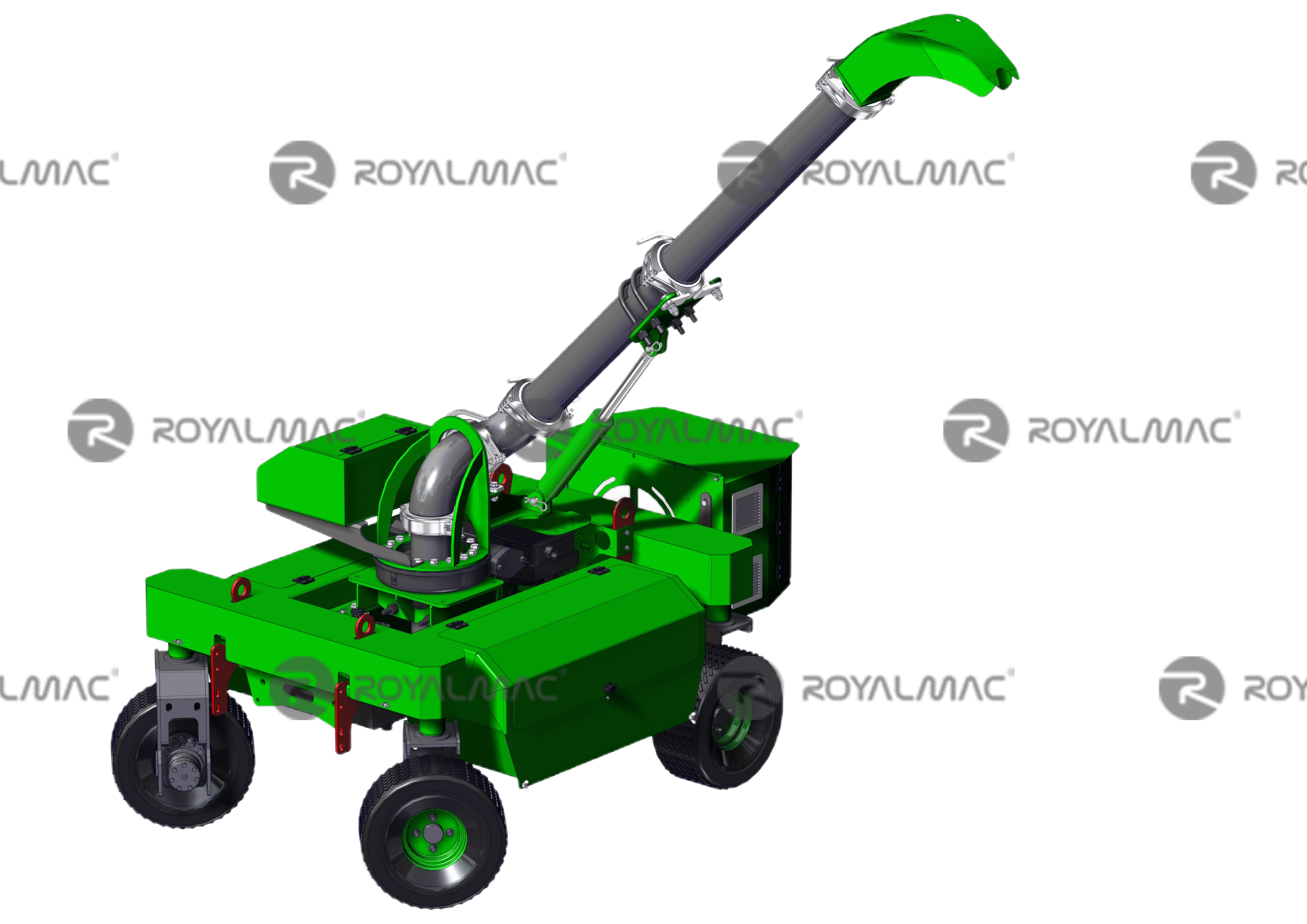
The Royalmac CC4 is a self-propelled concrete cobra placer built for pours where a placing boom is oversized and a wheelbarrow crew is too slow. It drives onto the slab under its own power, carries the delivery line on its own arm and places concrete exactly where the crew needs it — without a crane lift, without outrigger setup and without blocking the rest of the floor.
Power comes from a 13 hp Briggs & Stratton petrol engine, so the machine works on sites with no three-phase supply and no generator. All four wheels steer, and the steering system offers front, crab and mirror modes with a full 360° steering angle. In practice this means the CC4 can rotate on the spot inside a formwork bay, crab sideways along a wall line and reverse out of a dead end without a multi-point turn. Silicone-filled wheels remove the risk of punctures from rebar offcuts and nails, which is the most common cause of downtime for wheeled site equipment.
The placing arm reaches 2,370 mm horizontally and 3,150 mm vertically, and the pipe can be raised to the vertical so the machine feeds shear walls and columns from above rather than only flat slabs. The arm turns through 360° endless rotation, so the operator repositions the discharge point without moving the chassis.
At 850 kg total weight, 1,300 mm width and 170 mm ground clearance, the CC4 passes through standard site openings, crosses rebar mats and can be moved between floors on a normal construction hoist. Electronic parking and software-based control keep the machine stable when it is left loaded on a slope.
Frequently Asked Questions
Where is a concrete cobra placer used?
On slab, shear wall and column pours where a placing boom cannot be justified — floor-by-floor residential work, industrial floor slabs, car park decks and repair pours. It is also used on floors already closed off by formwork, where a boom has no line of approach.
Does the CC4 need electricity on site?
No. The CC4 runs on a 13 hp Briggs & Stratton petrol engine and is independent of site power. If you need a zero-emission machine for enclosed or indoor pours, the battery-powered CC4 E+ covers the same working envelope.
How much space does the CC4 need to work?
The machine is 1,300 mm wide and 3,350 mm long, with a 360° steering angle and front, crab and mirror steering modes. It turns within its own footprint, so a single formwork bay is enough to reposition it.
Can the CC4 pour vertical elements?
Yes. The delivery pipe can be brought to the vertical position, which allows shear wall and column pouring in addition to horizontal slab placement.
How is the CC4 transported between floors?
Total weight is 850 kg and ground clearance is 170 mm, so the machine is moved by construction hoist or crane in one piece — no disassembly and no reassembly time on the new level.